

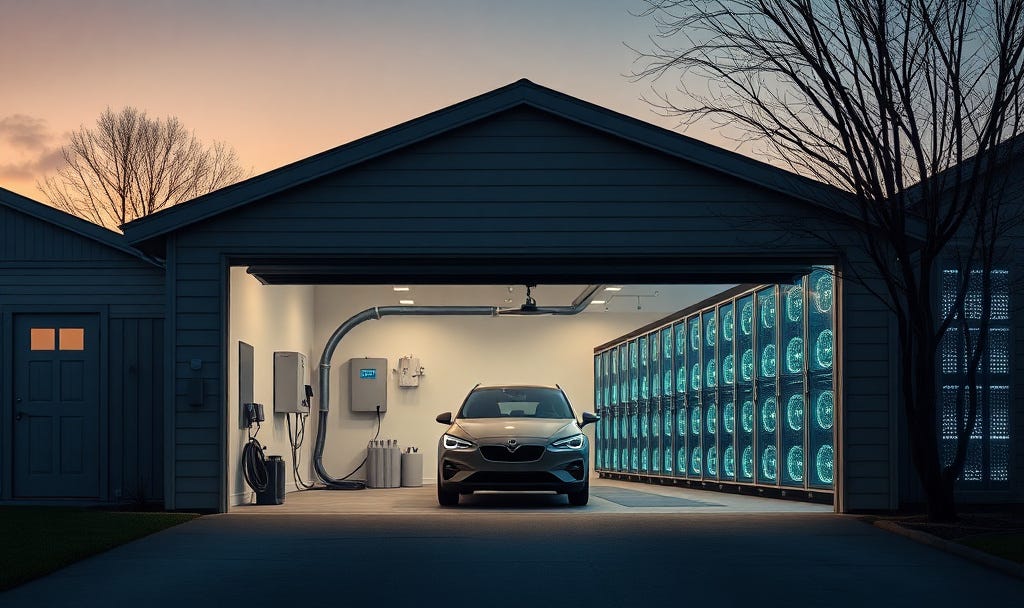
For most of the last century, the relationship between the family home and the electricity grid was remarkably simple. Electricity flowed from the grid into the home, where it powered lights, appliances and, more recently, electric vehicles. The home consumed electricity, the grid supplied it, and apart from a growing number of rooftop solar panels there was little reason to think much about that relationship.
That relationship is beginning to change.
On 24 June 2026, Sunrun, Tesla and Renew Home announced a framework to provide more than 16 gigawatts of fast, flexible power for AI data centres and other large electricity users by coordinating batteries, electric vehicles and smart energy devices already installed inside millions of homes.
Most of the technology behind that announcement was already familiar. Household batteries had been helping electricity companies balance the grid for years. Utilities had spent years encouraging households to become more flexible in how they used electricity, and the software needed to coordinate those devices was already in place.
What changed was not the technology. It was the role those technologies were beginning to play.
For perhaps the first time, millions of privately owned household energy devices were being assembled into infrastructure supporting one of the largest industrial expansions in modern history. Until now, those devices had been valued mainly for what they could do for homeowners and for the electricity system. Increasingly, they are also becoming part of the infrastructure that supports the AI economy.
Your garage was never designed for artificial intelligence. Yet the battery in your garage, the electric vehicle on your driveway and the thermostat on your wall may now contribute, alongside millions of other household devices, to the electricity system that increasingly underpins the AI economy.
Most homeowners have no reason to think about that connection.
Imagine three households.
A homeowner in Northern Virginia installs a battery to lower electricity bills. A family in Texas buys an electric vehicle because it is cheaper to run. A homeowner in London signs up to a flexibility tariff because it promises lower energy costs.
Each decision is personal. Each makes financial sense. None of those households believes it is participating in the AI build-out.
Yet, taken together, those ordinary household decisions can help create the flexible grid capacity needed to connect new AI data centres to the grid.
The electricity industry calls this a virtual power plant, or VPP. Despite its name, it is not a power station. It is software that coordinates thousands, and eventually millions, of household energy devices so they behave as one flexible resource.
The idea is not entirely new. Cloud computing transformed thousands of separate servers into a single computing platform. A virtual power plant applies the same principle to electricity by coordinating millions of independent household energy devices into a resource that the grid can draw on whenever it needs additional flexibility.
Until recently, that flexibility mattered because it helped electricity companies operate the grid more efficiently.
Artificial intelligence is giving that same flexibility a new economic purpose.
Household energy devices have not suddenly become useful to the electricity system. They already were. What is changing is the system they are increasingly helping to support.
The question is no longer whether your garage can help the electricity grid.
It is why that same contribution is suddenly becoming more valuable now?
The answer begins with a problem the electricity industry has been trying to solve for decades.
Electricity demand is not constant. Most of the time the grid has enough capacity to meet demand comfortably. The challenge comes during the busiest few hours of the year, when millions of homes, businesses and factories all need electricity at the same time. Those few hours determine how much generation, transmission and distribution infrastructure has to be built, even though much of it sits underused for most of the year.
That is why electricity companies have spent years encouraging households to become more flexible. Charging an electric vehicle overnight instead of early evening, allowing a home battery to supply electricity for a short period, or shifting other electricity use away from peak hours all help reduce pressure on the grid. None of those actions matters very much on its own. Across millions of homes, they become a meaningful source of flexibility.
For years, that flexibility was valuable because it helped the electricity system run more efficiently.
That is still true.
What has changed is who now needs that flexibility.
AI data centres require enormous amounts of electricity, often in parts of the grid that are already close to their limits. Expanding the grid is possible, but building new transmission lines, substations and other infrastructure often takes years.
That leaves the industry with an immediate problem. It needs more usable capacity long before new infrastructure can be built. Looking for ways around that constraint has revealed some unusual suspects. Household batteries, electric vehicles and smart thermostats were never installed to support AI infrastructure, yet together they are beginning to do exactly that.
Viewed individually, they are ordinary household devices. Coordinated across millions of homes, they become a source of flexible capacity that helps the electricity system accommodate new demand while larger infrastructure projects catch up.
The role of household energy devices therefore begins to change.
A battery is still bought to lower electricity bills. An electric vehicle is still bought for transport. A thermostat still regulates the temperature inside a home. Their original purpose has not changed.
What has changed is the value the electricity system can now create by coordinating millions of those devices together.
For homeowners, the reasons for buying those technologies remain exactly the same. People still want lower energy bills, greater resilience and cleaner energy. Very few are making those decisions because they want to support artificial intelligence.
Yet they may become participants in that system anyway.
That naturally raises a different set of questions.
If millions of privately owned household assets are creating value for a much larger system, who decides when those assets are used? How is that value shared? How much flows back to the households that own the assets, and how much remains with the companies coordinating the network?
Those questions reach beyond energy policy.
They are questions about ownership, incentives and market structure.
The same shift should also change how investors think.
Markets are usually quick to recognise new technologies because they are visible. They are often slower to recognise when familiar assets begin serving a different economic purpose because, on the surface, nothing appears to have changed.
The battery is still sitting in the garage.
The electric vehicle is still parked on the driveway.
The thermostat is still fixed to the wall.
The physical assets look exactly as they did before.
The network around them does not.
Sometimes the biggest investment opportunities do not begin with a new invention.
They begin when existing assets quietly become part of a different economy.