

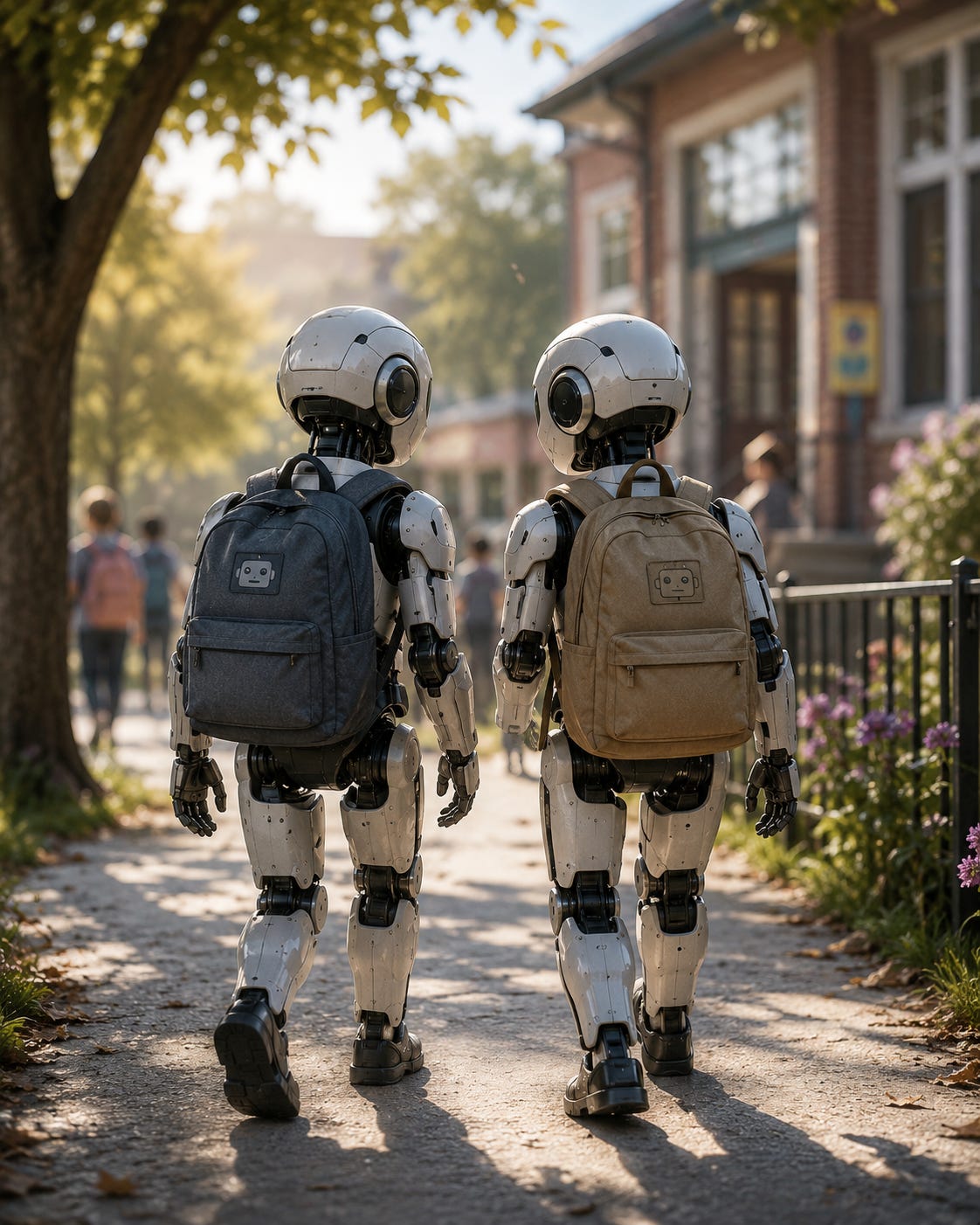
On 29 June 2026, thirty robots arrived for school in Hangzhou.
They came from manufacturing, services, security and entertainment, and they were there to prepare for work. Their curriculum included technical skills, healthcare, arts and sport. They would practise, be assessed and, if they met the required standard, receive professional certificates preparing them for what came next.
There is something remarkable about that reversal. For generations, some of the world’s brightest young engineers have travelled to places like MIT, Stanford, Carnegie Mellon, ETH Zurich and Tsinghua University to learn how to build intelligent machines. They studied mathematics, mechanical engineering and computer science, then spent years in laboratories trying to make those machines more capable. Humans went to school to learn how to build robots. Now robots are going to school.
Robots, of course, have been learning for decades. Industrial machines learned precise movements on factory floors, while researchers used demonstration, simulation, reinforcement learning and human guidance to teach robots to grasp, walk, balance and navigate. Boston Dynamics was putting machines through obstacle courses and testing their ability to recover from the unexpected long before today’s humanoid boom.
What is changing is the ambition for the kind of learning we want them to have. Rather than preparing a machine for a particular task or controlled range of situations, researchers are building richer environments in which robots can encounter more of the variation, mistakes and corrections through which humans learn to handle a world nobody can fully anticipate.
There is something familiar about that ambition because humans have never learned only by instruction. Long before a child enters a classroom, she has already spent years crawling across floors, dropping things, breaking things, watching other people, copying them and slowly discovering what her body can and cannot do.
Watch a toddler eating and you can see it happening. She reaches for a cup and knocks it over, grips something fragile too tightly or tries to put a spoon into her mouth and misses. Nobody explains pressure, balance or friction to her. She learns them by living in a body, and much of that learning happens through play.
On a playground, children climb and discover height, jump and discover distance, throw, catch, chase, fall, copy one another and invent games. They are not consciously preparing themselves for adult life. They are simply playing while thousands of encounters with the world quietly become part of what they know.
By adulthood, most of those lessons have vanished from memory even though the learning remains. I can pick up an egg without calculating the pressure between my fingers, adjust my grip when a glass is heavier than expected and step onto uneven ground without consciously thinking about balance. My hands know things I cannot remember teaching them.
There is a Michael Jackson song from 1995 called Childhood. Jackson had been performing professionally from the age of five and later spoke about feeling that he had missed many of the ordinary experiences other children had growing up. In the song, he asks a simple question: Have you seen my childhood?
You do not need to know the song for the question to make sense. Jackson was asking about something most of us take for granted: those ordinary years of playing, exploring, making mistakes and discovering the world for ourselves. What do those ordinary years give us that can be difficult to recover later?
It is an intensely human question. It also makes those thirty robots walking into school in Hangzhou look different.
They may already know how to walk, balance, grasp objects and perform complicated movements. What they do not have is the long, messy history through which a human child gradually discovers that the world rarely behaves exactly as expected.
That is what makes the Hangzhou school part of a much larger development. In Beijing, robots are being trained across dozens of settings resembling homes, shops, offices, factories and healthcare environments. Across the Pacific, Agility Robotics has opened a 60,000-square-foot facility in California where its humanoid robot, Digit, can learn and test skills before taking them into customer workplaces.
What matters is the effort to widen the world around the machine: more situations, more variation, more kinds of physical interaction and more opportunities for something unexpected to happen. The laboratory is beginning to acquire some of the characteristics of a playground.
The first great wave of modern AI had an advantage these machines do not. Long before today’s large language models arrived, humanity had accidentally created an enormous record of what it knew. For decades, we filled the internet with books, photographs, scientific papers, computer code, newspapers, instructions, conversations and arguments.
The physical world left no comparable archive. There are not billions of neatly recorded examples of exactly how tightly to hold a strawberry, how to lift a wet glass or what to do when a box coming down a conveyor has been crushed on one side. Language can describe those things, video can show them and simulation can reproduce parts of them, but physical intelligence ultimately has to deal with a world that refuses to remain as tidy as the training example.
This is where scale begins to matter. China installed 295,000 industrial robots in 2024, more than half of all industrial robot installations worldwide. Behind that number are factories, warehouses and logistics networks full of damaged packaging, unfamiliar surfaces, badly positioned objects and thousands of other small departures from what was expected. These are not simply places to deploy machines. They are places where machines can encounter the untidiness of real work.
Another piece moved closer in August when DeepSeek invested $20.8 million in Unitree. DeepSeek is building increasingly capable machine intelligence, while Unitree is building increasingly capable bodies for it to inhabit. Around them is a growing physical world in which those bodies can learn.
The intelligence, the body and the playground are beginning to meet.
Eventually, however, the student has to leave school.
To see where this could lead, follow one of those graduates into an imagined first day at work. It has taken a job in a warehouse, lifting boxes from a conveyor and stacking them onto pallets. It knows the task, and for most of the day the work proceeds exactly as expected.
Later in the shift, a box arrives with one side crushed. The robot grips it in the usual place, the weakened cardboard folds beneath its hand and the box begins to slip. A supervisor standing nearby catches it, turns it around, supports the damaged side from underneath and places it safely on the pallet before returning to her work.
The following morning she returns to the same line, where another robot is working. Later in the shift, another damaged box appears. She notices it approaching and looks towards the machine, perhaps expecting yesterday’s problem to repeat itself, but the robot turns the box, supports the damaged side from underneath and places it safely on the pallet.
What makes the moment remarkable is that she never taught this robot how to handle the damaged box. The correction she made with one machine yesterday has somehow become available to another machine today.
For humans, that distinction has always mattered. We have spent thousands of years finding better ways to pass instruction forward, from stories and books to schools, libraries and eventually the internet. Each invention has allowed someone else to begin with knowledge they did not personally have to discover.
What we could never pass forward was the experience that produced it.
I can tell my daughter what happened to me, warn her about mistakes I made and give her the benefit of things it took me years to understand, but I cannot give her the years themselves. However carefully I prepare her for the world, she must still touch it, misjudge it, fall, adjust and discover some things for herself.
The robots entering these new schools may also need practice, mistakes, correction and encounters with a world they do not yet understand. Somewhere, one machine still has to meet the damaged box for the first time, and perhaps a human hand still has to reach across and show it another way. But what is learned through that encounter need not remain with the machine that lived through it.
As these machines move into factories, warehouses, hospitals, farms and eventually homes, the boundary around their school begins to disappear. The world becomes part of the classroom, while something learned by one machine in one place can become part of what another brings to a place it has never been.
Which brings us back to those thirty robots walking into school in Hangzhou. At first, they look like strange versions of ourselves. They need teachers, practice, mistakes and something increasingly like a playground.
We learned how to pass on the instruction. We never learned how to pass on the childhood.
The robots may.
They may be the first students in history who can leave school carrying lessons from experiences they never personally lived.
You’re describing when machines accumulate what humans can't pass forward, the historical correction experiences themselves. We inherit stories of experience, but not the experience. Robots inheriting adjustments means they’re building a new kind of history -- a record of coherence preserved through shared correction rather than memory. Robots are beginning to bypass the articulation of coherence without narrative, which is the imperfect human way. That's a little scary.